When a jobseeker scrolls through an online jobs board, every listing card occupies the same space on the screen. Behind those cards, however, a single advert can represent either one specialist vacancy with a single salary figure or a multi-hire campaign advertised inside a wide pay band.
Original analysis of our 3 November 2026 snapshot of The UK Careers Fair Jobs Board — captured at 21:38:37 UTC — shows how strongly multi-opening recruitment and ranged pay disclosure vary by pay unit and working pattern. At the snapshot moment, the public board held 787 live, unexpired listings from 189 employer accounts (with zero date-expired records left live): 698 job listings from 170 employers, 25 apprenticeships from seven employers, 55 training courses from nine accounts and nine other opportunity listings from nine accounts, with employer totals overlapping across categories.
Across the 698 live job adverts, employers entered 5,764 stated openings, alongside 124 stated openings across the 25 apprenticeships, 55 across the 55 courses and 137 across the nine other opportunities. Multi-opening recruitment was concentrated in 194 of the 698 job adverts, one apprenticeship advert and four opportunity listings — and within structured job cohorts, volume hiring behaved very differently in hourly roles than in salaried annual posts.
Where multi-opening adverts cluster on the board
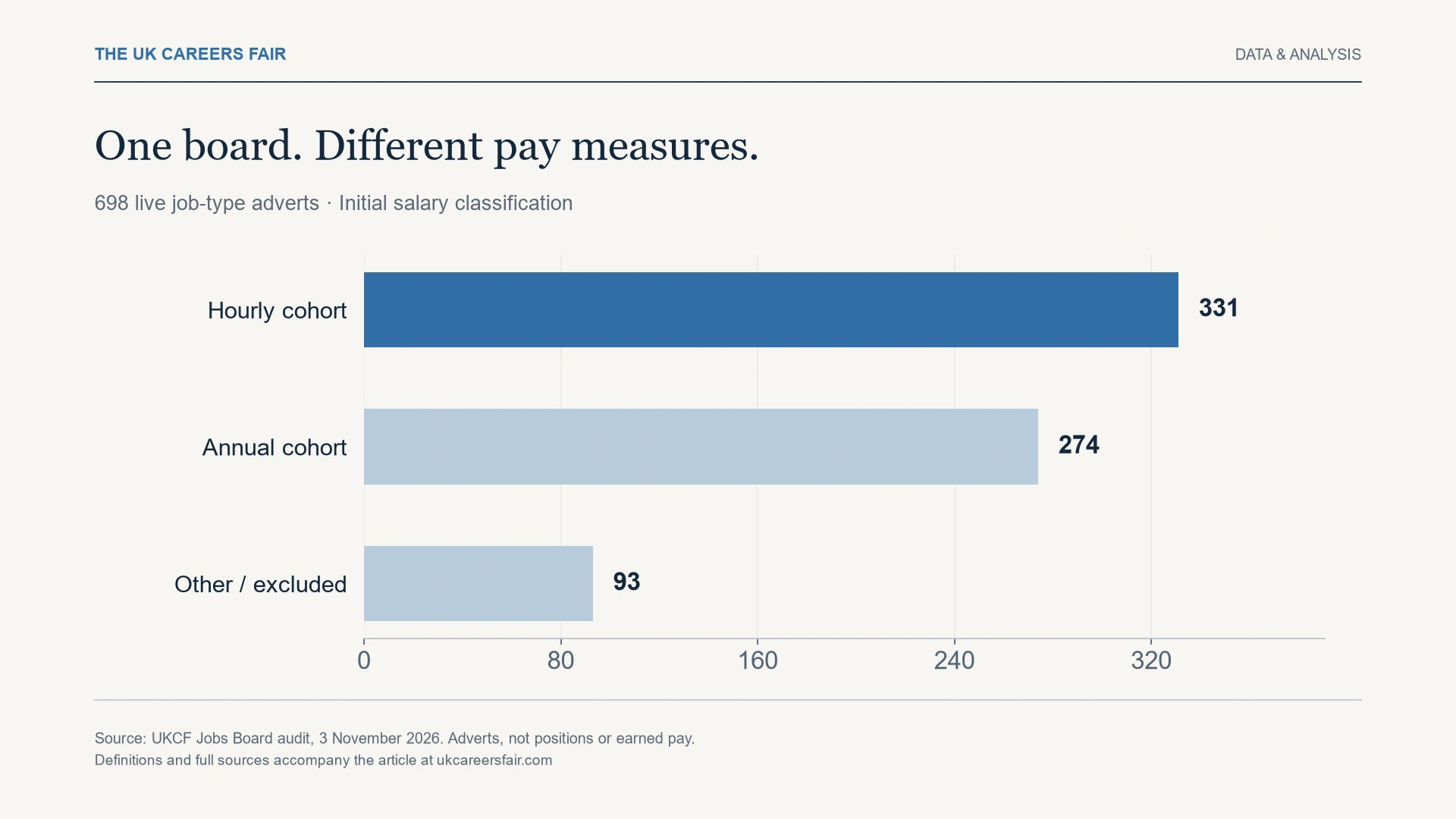
To examine pay disclosure without mixing incompatible units, our salary-audit classification separates structured annual (274 job adverts) and hourly (331 job adverts) listings after excluding courses, general opportunities, 21 voluntary or volunteer-labelled job listings, three commission-only job records, 63 job adverts (and 10 apprenticeships) without a positive structured lower pay bound, three invalid descending salary ranges and three job adverts using other or missing pay units (including two daily and one monthly listing in the raw period field, alongside 21 job listings with a null salary period).
Within the resulting structured cohorts, full-time hourly jobs were far more likely to advertise multiple openings under one listing than full-time annual jobs. Of the 182 structured full-time hourly job adverts, 106 stated more than one opening — compared with 50 multi-opening adverts among the 251 structured full-time annual job listings, and 10 multi-opening adverts among the 132 part-time hourly job listings. Temporary hourly jobs showed a similar concentration on a smaller base, with six multi-opening adverts out of 11 listings, alongside two out of six contract hourly listings and one out of three contract annual listings.
| Listing & employment type | Pay unit | Live adverts | Ranged pay adverts | Multi-opening adverts | Quoted lower–upper span |
|---|---|---|---|---|---|
| Job · Full Time | Year | 251 | 178 | 50 | £5,000 – £110,000 |
| Job · Full Time | Hour | 182 | 146 | 106 | £12.21 – £60 |
| Job · Part Time | Hour | 132 | 21 | 10 | £12.70 – £35 |
| Job · Part Time | Year | 20 | 17 | 4 | £18 – £200,000 |
| Job · Temporary | Hour | 11 | 8 | 6 | £12 – £20 |
| Job · Contract | Hour | 6 | 2 | 2 | £12.75 – £31 |
| Job · Contract | Year | 3 | 3 | 1 | £26,000 – £38,525 |
| Apprenticeship · Full Time | Year | 14 | 6 | 1 | £11,778 – £52,000 |
| Apprenticeship · Full Time | Hour | 1 | 1 | 0 | £13.50 – £16.50 |
Ranged pay dominates full-time adverts — but not part-time hourly roles
Salary ranges rather than single point figures were the norm across full-time adverts in both units. Among the 251 structured full-time annual job adverts, 178 quoted both a lower and an upper figure, as did 146 of the 182 full-time hourly job adverts and 17 of the 20 part-time annual job adverts. By contrast, only 21 of the 132 structured part-time hourly job adverts quoted a range, leaving the large majority with a single hourly starting rate. Among the 14 structured full-time annual apprenticeships, six quoted a range, whilst the single structured hourly apprenticeship quoted £13.50 to £16.50.
Those structural differences shape what applicants need to ask. A part-time hourly role quoting a single figure sets a clear hourly floor, leaving weekly earnings dependent on guaranteed rota hours. A full-time annual or full-time hourly role quoting a wide band may reflect shift allowances, overtime rates, regional pay zones across locations from Reading to northern cities in our location directory, or progression grades best clarified at interview or face-to-face at a recruitment event.
Strict limits on what platform listings can prove
Platform records require the same discipline applied to official series such as the ONS Vacancy Survey (which estimated 691,000 UK vacancies in July to September 2026) and the ONS Annual Survey of Hours and Earnings (provisional April 2026 median full-time annual employee pay of £40,911). As the ONS guide to labour market statistics emphasises, online advert counts and official survey estimates measure distinct populations.
Four cautions govern our snapshot. First, employer-stated openings (5,764 across 698 job adverts) are unverified recruiter entries, not audited vacancies or hires; each multi-opening listing counts once in advert totals and is never weighted into pay-disclosure rates. Second, annual and hourly cohorts cannot be pooled without contracted-hours information, and employer-supplied labels such as “Full Time” or “Part Time” are not audited full-time-equivalent hours. Third, quoted bounds include unverified extremes — such as £5,000 in full-time annual jobs or £18 in part-time annual jobs — illustrating why submission fields still require human verification. Fourth, unpriced legacy records remain in the denominator: across all 698 job adverts, 359 carried a null legacy pay-structure value alongside 318 marked “salary”, 18 “voluntary” and three “commission” (and among 25 apprenticeships, 23 were null and two marked “salary”), whilst 631 job adverts showed a numeric GBP display string compared with 612 holding a positive structured lower bound (across the 787-listing board, 28 records had a numeric display without a structured lower bound and 49 lacked a pay display).
Sources and method
- The UK Careers Fair: Jobs Board advertised-pay methodology and JSON dataset; live, unexpired snapshot observed on 3 November 2026 at 21:38:37 UTC.
- ONS: Vacancies and jobs in the UK, October 2026; July–September 2026 vacancy stock concepts.
- ONS: Employee earnings in the UK, 2026; provisional April 2026 employee earnings benchmark.
- ONS: A guide to labour market statistics; comparison of administrative, survey and advert measures.
About this reporting: The UK Careers Fair Limited publishes this article, organises recruitment events and operates The UK Careers Fair Jobs Board, in which it has a commercial interest. Counts describe adverts from participating employers on 3 November 2026, not representative UK vacancies or wages. Review our editorial standards, full data appendix and corrections policy.