
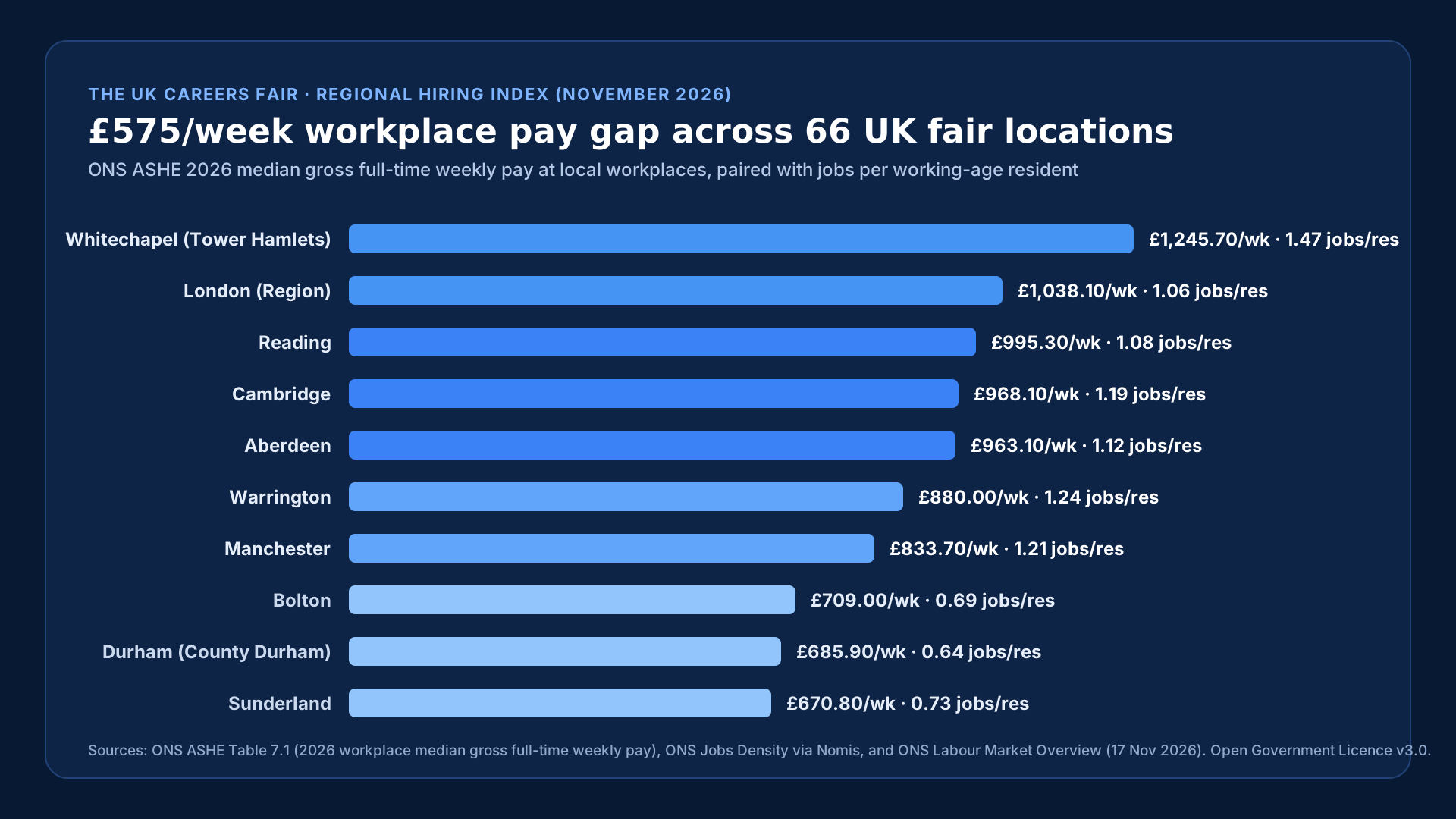
Annual growth in Great Britain’s regular weekly earnings eased to 3.5% in July to September 2026—worth 0.2% in real terms after CPIH inflation—according to Office for National Statistics figures released on 17 November 2026. Yet pairing those national earnings and sector vacancy trends with 2026 Annual Survey of Hours and Earnings (ASHE) workplace data across 66 UK locations in The UK Careers Fair Regional Hiring Index reveals a £574.90-a-week gap between the highest- and lowest-paying local workplaces—equivalent to £29,895 a year for a full-time employee.
Across the 66 local authorities and city regions with published 2026 ASHE Table 7.1 workplace medians in our event network, gross full-time weekly pay runs from £1,245.70 in Tower Hamlets (Whitechapel) and £1,038.10 across London as a whole, followed by Reading (£995.30), Cambridge (£968.10), Aberdeen (£963.10) and Guildford (£914.20), down to £670.80 in Sunderland, £685.90 in County Durham and £689.20 in Cornwall (Truro).
Public-sector pay outpaced private hiring as 11 of 18 sectors trimmed vacancies
In the November 2026 Average Weekly Earnings bulletin, public-sector regular pay rose by 5.4% year on year in July to September 2026 as earlier public-service settlements fed through payrolls, compared with 3.1% regular pay growth across the private sector. Over the same release cycle, ONS’s Vacancies and jobs bulletin recorded 690,000 UK vacancies in August to October 2026, down 22,000 on the quarter.
Sector-level movements explain why salary pressure and candidate competition vary sharply by occupation on The UK Careers Fair Jobs Board. Quarterly vacancy reductions were concentrated in administrative and support service activities (-5,000), construction (-5,000), and transport and storage (-5,000), whereas employers recruiting in healthcare and nursing, engineering and technical roles, and education and training continue to compete against tighter local qualification pools and firmer public-sector pay benchmarks.
Neighbouring cities diverge sharply on workplace pay and job density
Because ASHE Table 7.1 measures earnings at the place of work rather than where workers live, combining it with ONS Jobs Density estimates (workplace jobs per resident aged 16 to 64) separates regional employment hubs from commuter towns just a few stops away on the rail network:
- North West: Warrington (£880.00/week; 1.24 jobs per working-age resident) and Manchester (£833.70/week; 1.21 jobs density) sit more than £124 to £171 a week above nearby Bolton (£709.00/week; 0.69 jobs density).
- Greater London: Workplace full-time median pay in Tower Hamlets (Whitechapel, £1,245.70/week; 1.47 jobs density) exceeds outer-borough Croydon (£864.80/week; 0.51 jobs density) by £380.90 a week, reflecting Canary Wharf and City-fringe financial and digital employers.
- South East & East of England: Winchester (1.34 jobs density; £858.30/week) and Cambridge (1.19 jobs density; £968.10/week) draw net inbound commuters, whereas Medway / Gillingham (0.62 jobs density; £761.60/week) and Southend-on-Sea (0.69 jobs density; £740.40/week) export a high share of working residents to neighbouring centres.
Methodological notes for journalists and recruiters
ASHE workplace figures cover gross weekly pay for full-time employee jobs on adult rates whose pay for the survey pay-period was not affected by absence. Annualised illustrations (multiplying weekly pay by 52) are rough full-time benchmarks rather than contracted salaries, and part-time, shift-based, and apprenticeship pay structures differ substantially by sector. Northern Ireland workplace earnings for Belfast follow NISRA’s Annual Survey of Hours and Earnings methodology alongside Great Britain’s ONS table.
Journalists, researchers and local-authority teams can inspect, filter and cite all 67 locations in our open UK Regional Hiring Index (published under CC BY 4.0 alongside Open Government Licence v3.0 source links), or compare live employer-posted salaries directly on city hubs such as Jobs in Birmingham, Jobs in Leeds and Jobs in Glasgow.
Sources and method
- ONS: Average weekly earnings in Great Britain, November 2026, released 17 November 2026 (July to September 2026 reference period).
- ONS: Vacancies and jobs in the UK, November 2026, released 17 November 2026 (August to October 2026 reference period).
- ONS: Annual Survey of Hours and Earnings (ASHE) Table 7.1a, 2026 provisional workplace gross weekly pay for full-time employee jobs across local authorities.
- ONS via Nomis: Jobs Density, workplace jobs per resident aged 16–64 across UK local authorities.
About this reporting: Published by The UK Careers Fair Limited, organiser of UK recruitment events and operator of the Jobs Board. Official statistics are reproduced under the Open Government Licence v3.0; our compiled multi-city dataset is available at /editorial/regional-hiring-index/. Read our editorial standards and corrections policy.