
The latest official estimate shows fewer vacancies in the UK. An audit of The UK Careers Fair’s own records, meanwhile, identifies 145 accepted organisation-event commitments for 2027. The apparent tension disappears when the two measures are examined: one describes unfilled posts, the other a decision to participate in a future event.
The ONS release published on 20 October estimates 691,000 vacancies in July to September 2026, down 21,000, or 2.9%, from April to June. It gives an approximate uncertainty interval of plus or minus 32,000 around the vacancy estimate. The quarterly figures deserve attention without being treated as an exact count or a forecast.
The newly audited booking snapshot, taken at 21:35 UTC on 3 November, establishes something narrower about the future. Accepted commitments cover 72 events in 50 cities. They represent 81 normalised organisation labels, including employers, recruiters, training and support organisations. They are not 81 employers each promising to hire.
A vacancy and a future conversation run on different clocks
The ONS methodology describes the headline vacancy measure as a seasonally adjusted three-month average of posts for which organisations are actively seeking external recruits. A fair booking has no equivalent test of how many positions are open. It records participation, not a count of those positions or the date they will be filled.
This leaves room for several possible explanations of the bookings. An organisation might be preparing for a later recruitment window, developing awareness of an occupation or offering a route into training. Those are plausible reasons to attend, rather than motives measured by this audit. Establishing them would require asking participants.
Even where an exhibitor is recruiting, the decisions need not be simultaneous. Choosing an event for next spring and authorising a particular vacancy today are distinct commitments. Neither the booking record nor the national vacancy total tells us whether they belong to the same recruitment plan.
The first-half calendar is already taking shape
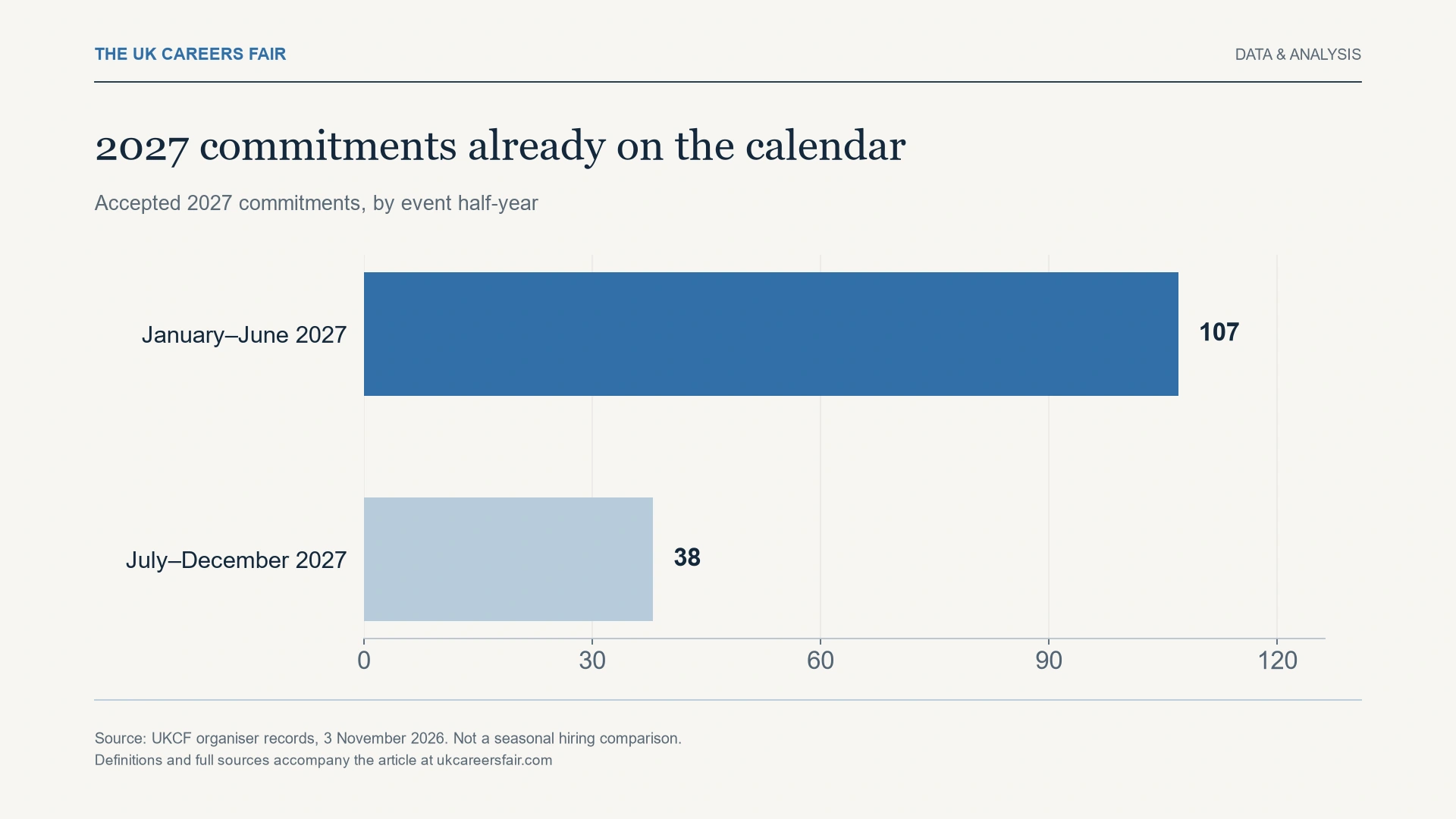
Of the 145 commitments, 107 relate to events between January and June 2027; the remaining 38 fall in the second half. The first-half commitments cover 47 events and 45 cities. These are counts from the same administrative snapshot, rather than evidence that recruitment demand will be stronger in one half of next year.
The distinction matters because the programme is still being booked. Across the full year, the current schedule contains 110 events in 63 cities, while accepted participation has reached 72 events. An event without an accepted booking in this snapshot is not an event at which no organisation will eventually participate.
Acceptance also differs from payment. The audited total includes accepted bookings with mixed payment statuses; an issued invoice can denote acceptance under the organiser’s terms. Duplicate organisation-event records and effective cancellations have been reconciled. Calling the resulting total paid stands would change both the definition and the claim.
What would turn planning into stronger evidence?
A useful next stage would track what follows each commitment: confirmed participation, the kind of opportunity discussed and, where relevant, subsequent recruitment outcomes. Those stages should remain separate. A training conversation can be worthwhile without generating an immediate job offer, and a booked exhibitor does not establish that a candidate has been hired.
A trend would require another comparable snapshot, using the same inclusion rules and a clear reference point. There is no reliable same-stage prior-year benchmark in the current audit. Historical migration means the observed 2026 records cannot support a year-on-year growth claim for the incomplete 2027 booking window.
For jobseekers, the actionable question is therefore specific: what will a particular organisation be able to discuss at a particular event? Check the current participant information, distinguish employment from training or support, and establish the next application step. The published events calendar provides the starting point for that research.
For participating organisations, the corresponding discipline is to explain the purpose of attending. Clear information about live roles, later recruitment or another service makes an early commitment more useful to a visitor. The audit supplies evidence that future conversations are being arranged. Whether those conversations become opportunities, applications or appointments remains work to be done.
Sources
- The UK Careers Fair, audited 2027 booking snapshot, 3 November 2026.
- ONS, Vacancies and jobs in the UK: October 2026.
- ONS, A guide to labour market statistics.
About this reporting: The UK Careers Fair organises the events and operates the Jobs Board discussed here. Booking figures are a snapshot at 21:35 UTC on 3 November 2026; the board-wide salary audit is at 21:38 UTC. They are not representative estimates of UK employment. Read the definitions, limitations and aggregate data. Charts are original visualisations of the cited figures.