
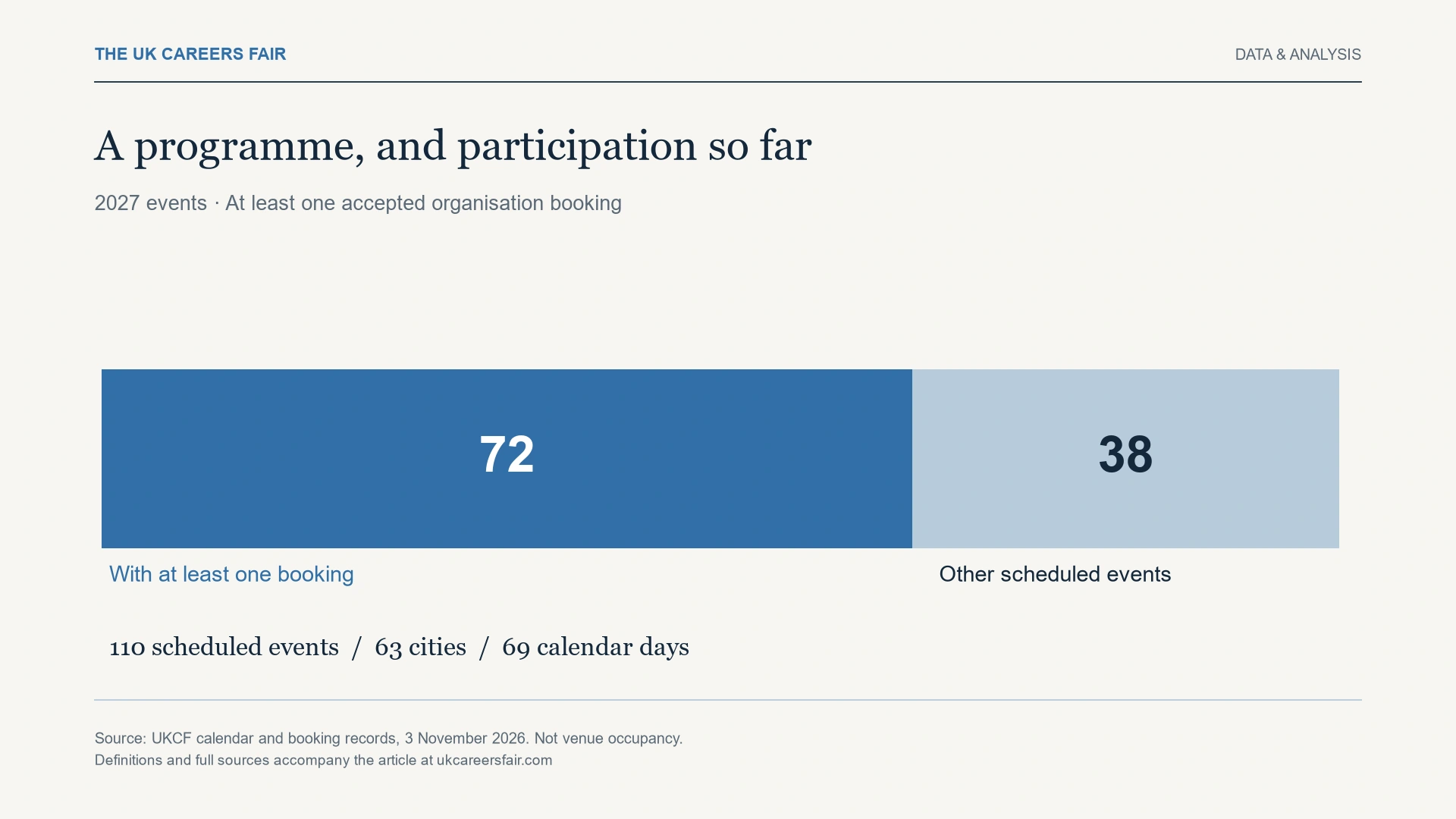
A published event date and a settled exhibitor list are different things. That distinction is central to the UK Careers Fair’s 2027 programme, which currently contains 110 scheduled events across 63 cities, with at least one active organisation booking recorded for 72 of those events.
The figures, reconciled on 3 November, put a useful frame around a large national calendar. Fifty cities already have recorded participation. Thirteen scheduled cities do not yet have a booking in the audited dataset. Neither group should be read as a ranking of local employment prospects.
The public events calendar is the source for dates and venues. The new booking dataset adds a second layer: where accepted participation has been recorded so far. Together, they let readers distinguish a plan to hold an event from the organisations already associated with it.
A calendar is an offer of access
The programme spans the nations and regions of the UK. Its largest regional allocations by number of scheduled events are the North West, with 14, and Yorkshire, with 13. The South West has 12; Scotland and the South East each have 11. Northern Ireland has two events in one city.
Those counts describe this organiser’s programme. They reflect where and when it has scheduled fairs, not each region’s share of national vacancies. A region with more event dates also presents more opportunities for an organisation to appear in the booking total. Comparing raw bookings without that calendar denominator would confuse the size of the offer with the response to it.
Consider the South East and South West. Nine events in each region have at least one recorded booking, against programmes of 11 and 12 events respectively. The matching booked-event total therefore describes slightly different calendar coverage. It says nothing by itself about venue capacity, the number of staff an exhibitor needs or the quality of the opportunities a visitor might find.
At the other end of the table, no Northern Ireland event has an active booking in this snapshot. The programme still contains two scheduled dates there. A zero at this stage means no qualifying record in this dataset; it does not mean an event has been cancelled or that local employers have stopped hiring.
What is known, and what remains open
The cleanest summary is three separate counts. There are 110 scheduled events; 72 have recorded organisation participation; and those bookings amount to 145 distinct organisation-event commitments. The last figure counts the same organisation again when it books another fair. It does not count jobs.
The 38 scheduled events without a recorded booking remain part of the calendar at the audit date. Readers should resist filling that information gap with assumptions. The bookings are being observed months before most of the programme takes place, and this exercise does not measure the final size of any event.
There is also a geographical distinction hidden inside the word “date”. Two fairs can take place in different cities on the same day. The programme’s 110 events occupy 69 calendar days; the 72 events with bookings occupy 53. For an organisation planning staff travel, the event location matters as much as the date.
Choose a fair around the conversation you need
For a candidate, the calendar is most useful as a way to narrow a search. Start with a practical location and date, then check the organisations and routes associated with that particular event as information becomes available. A fair in a larger city is not automatically a better fit than a nearby event with the right participants.
For an employer or provider, a national programme offers a choice between a focused local appearance and a wider schedule. The booking records already include both: 62 organisation names appear at one event, while 19 appear at several. The exhibiting information explains the organiser’s commercial offer; it should be considered alongside the organisation’s own audience, staffing and follow-up capacity.
These numbers are a starting position, not a finished roll call. Publishing the distinction now gives candidates and exhibitors a more honest basis for planning—and gives future updates a baseline against which genuine changes can be measured.
About this reporting: The UK Careers Fair organises the events and operates the Jobs Board discussed here. Booking figures are a snapshot at 21:35 UTC on 3 November 2026; the board-wide salary audit is at 21:38 UTC. They are not representative estimates of UK employment. Read the definitions, limitations and aggregate data. Charts are original visualisations of the cited figures.