
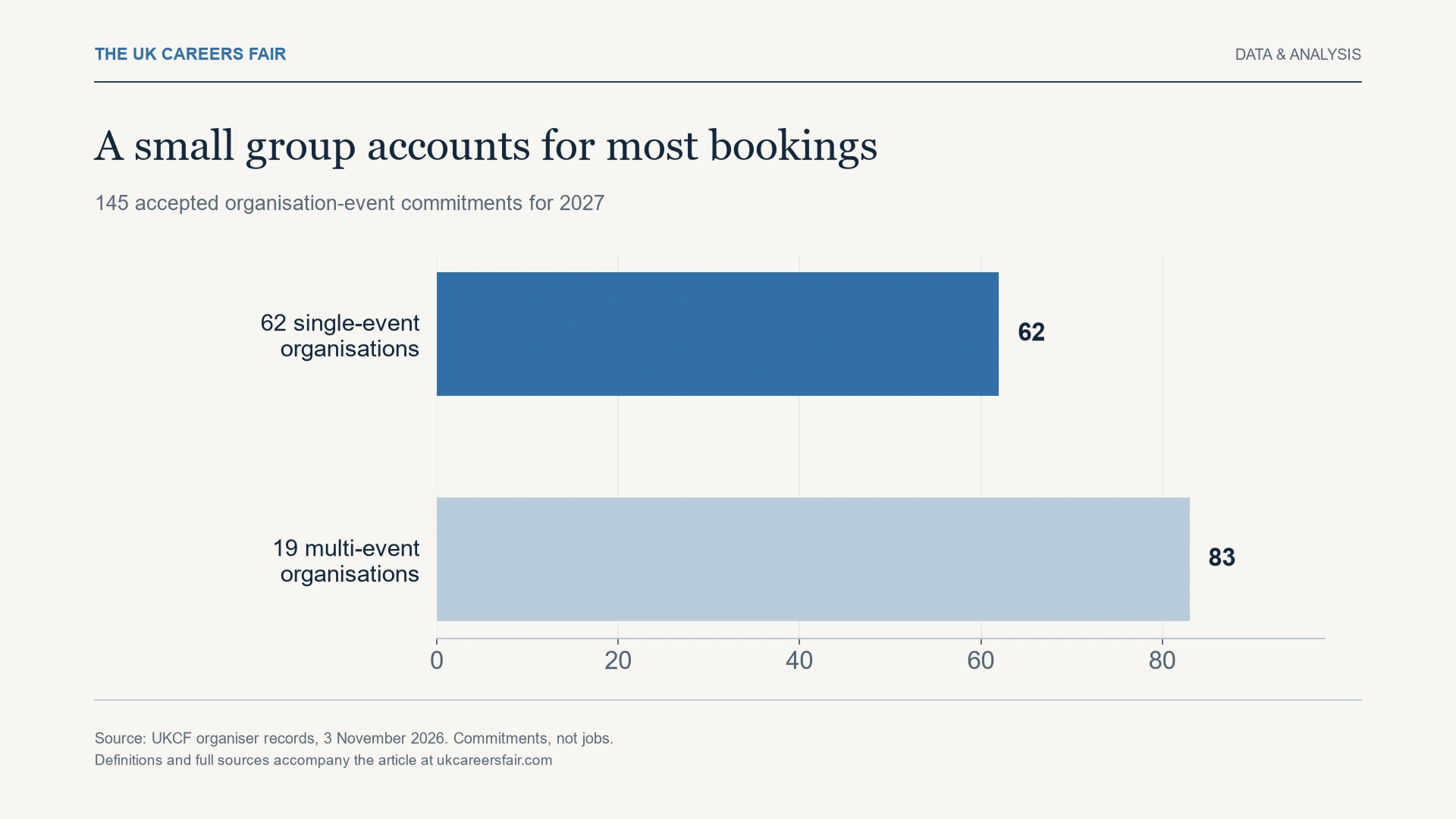
Nineteen organisations account for more than half of the event commitments recorded so far for The UK Careers Fair’s 2027 programme, an analysis of the organiser’s booking records shows. Together, they hold 83 of 145 commitments, while 62 other organisations have booked one event each. The figures offer an early view of how participation is distributed across a national programme before most of its fairs take place.
The snapshot, taken on 3 November 2026, counts a commitment as one normalised organisation name at one current event. It expands packages into their individual dates, follows bookings moved to another fair and removes cancellations and duplicate entries. The 145 commitments therefore represent 81 organisation labels. They are a measure of planned participation, with each appearance counted separately.
A small group, a larger share of appearances
The concentration is substantial. The 19 organisations with more than one booking represent 23.5% of the recorded organisation labels and 57.2% of the commitments. Ten have booked two events, three have booked three and three have booked five. One organisation has eight commitments, another nine and another 22. Those figures describe the distribution within the current ledger; the bookings have not been assessed as a representative sample of UK employers.
Fourteen of the 19 are booked into more than one city. The distinction matters because repeat appearances need not involve a wider geographical circuit: an organisation can attend several dates in the same city. Equally, a multi-city booking does not establish how many vacancies an organisation has, which occupations it needs or whether the same recruiting team will staff every stand.
At this stage, the most useful finding is about the structure of the programme. A relatively small group contributes many of the planned appearances, alongside a larger group making a single recorded commitment. The data cannot establish why either group chose that pattern. It contains no surveyed account of recruitment strategy, budget decisions or the relative effectiveness of individual fairs.
What candidates can read from the pattern
For candidates, the figures help explain why counting events and counting organisations answer different questions. An organisation appearing in several cities creates several opportunities to meet its representatives. Seeing its name on a second event list does not, by itself, establish that it is advertising another set of jobs. Candidates still need to ask which roles the team is discussing, where those roles are based and what the application route involves.
The same care applies when comparing line-ups. A familiar name appearing repeatedly can be useful to someone who missed an earlier date or needs a nearer venue. The event calendar provides the date and place; an employer’s current vacancy information provides a separate part of the decision. Neither the number of appearances nor the size of a stand settles questions about pay, hours, location or progression.
The organiser’s records also require a distinction between a booking and a completed payment. Published exhibitor terms treat an issued invoice as acceptance of a booking. Uncancelled invoice bookings are included in this analysis alongside other accepted records. The methodology does not describe the resulting total as paid stands, and the event arrays do not provide a sufficiently reliable measure of physical stand quantities.
An early baseline for later reporting
The snapshot is a starting point for observing changes in the programme. Later reporting could show whether more single-event organisations join, whether existing participants add dates or whether cancellations alter the distribution. Each would change the relationship between the number of organisations and the number of appearances. The present records cannot establish those future developments.
They also cannot support a claim that multi-event participation is growing year on year. No comparable booking snapshot from the same point in the previous year has been established. Imported records carry placeholder receipt dates, which prevents those fields from reconstructing a dependable historical sales timeline. A larger or smaller total from a different event cohort would not resolve that problem.
The clear finding is narrower and useful: the early 2027 programme combines 62 single-event participants with 19 organisations responsible for most recorded appearances. Keeping both counts visible gives candidates and exhibitors a more accurate picture of the developing programme than either total could provide alone.
Source and method
The UK Careers Fair booking snapshot, 3 November 2026: definitions, reconciliation, frequency table and limitations. Organisation names are normalised administrative labels, rather than an audited count of legal entities. The report analyses the organiser’s own records.
About this reporting: The UK Careers Fair organises the events and operates the Jobs Board discussed here. Booking figures are a snapshot at 21:35 UTC on 3 November 2026; the board-wide salary audit is at 21:38 UTC. They are not representative estimates of UK employment. Read the definitions, limitations and aggregate data. Charts are original visualisations of the cited figures.