
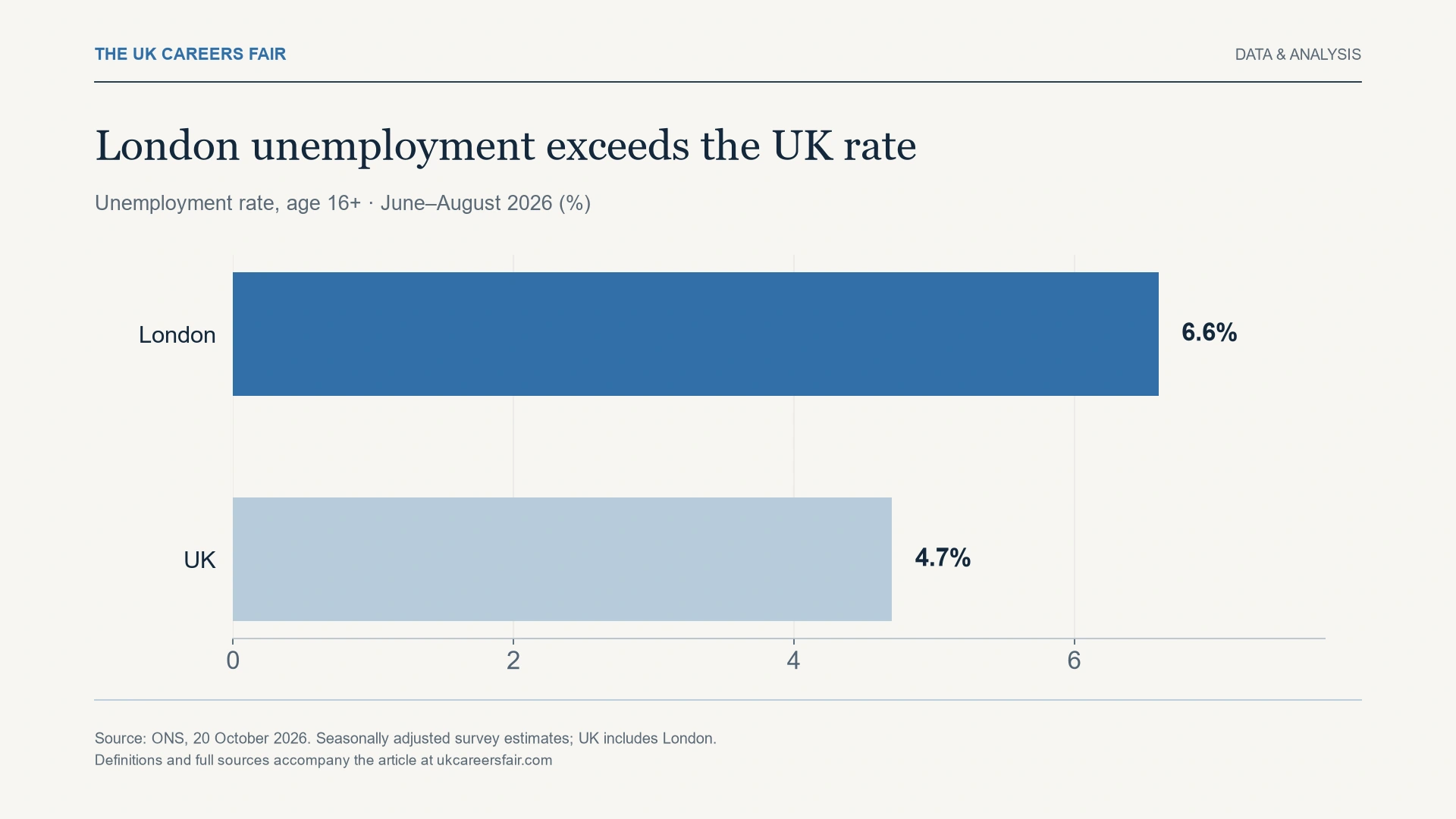
Thirty-seven organisation names appear in The UK Careers Fair’s reconciled booking records for this Friday’s London event, according to a snapshot taken on 3 November. The gathering comes against a difficult backdrop: the capital had the UK’s highest unemployment rate in the latest regional estimates.
The two facts describe different things. A booking shows a commitment to participate in an event. It does not establish how many jobs an organisation has, who can secure them or whether the meeting will produce a hire. The distinction matters when employer access is presented as part of a response to unemployment.
The London Careers Fair takes place at Hornsey Town Hall on Friday 6 November, from 10am to 2pm, with free candidate entry. The UK Careers Fair Limited, which publishes this article, operates the event and its associated Jobs Board.
A regional problem, measured across residents
ONS figures released on 20 October put London’s unemployment rate at 6.6% in June to August 2026, against 4.7% for the UK. These are seasonally adjusted Labour Force Survey estimates. The 1.9 percentage-point difference describes the reported rates; it does not explain why they differ.
The denominator is economically active people aged 16 and over, rather than every resident. ONS also identifies these regional measures by where people live, which may differ from where they work. A London-wide estimate cannot be read as a measure of unemployment around the venue in Crouch End.
The statistical caution is material. ONS warns about sampling variability and volatility, particularly in granular breakdowns, and advises against drawing strong conclusions from short-term changes. Friday’s attendance, whatever its size, will not validate or overturn a regional household-survey estimate.
What the organiser’s records actually establish
The booking snapshot and method record 37 normalised organisation names for the London event at 21:35:16 UTC on 3 November. Duplicate organisation-event entries were collapsed and recorded changes and cancellations applied. Name normalisation is not an audit of legal entities or corporate groups.
This is therefore a count of organisations recorded in the ledger, subject to those identity limits. It should not be promoted as 37 employers with open jobs, 37 paid stands or a forecast of how many organisations will physically attend.
The public profiles of the Metropolitan Police, Deaf Progress and Reeta Vickers Recruitment Ltd connect them with the London fair. They illustrate why an organisation count requires interpretation: the services and recruitment conversations represented are not interchangeable.
The Metropolitan Police profile, for example, linked to Friday’s fair while showing no live listings on this Jobs Board when checked. That establishes a limit of the board’s coverage, rather than proving the organisation has no vacancies elsewhere. An event roster and an online vacancy list answer different questions.
Access is an input, not an outcome
The immediate value of a recruitment conversation is specific. A candidate can establish whether an opportunity exists, where the work happens, which requirements are essential and how an application will be assessed. An organisation can explain a route that a short advert leaves unclear. Whether that exchange produces a suitable application remains to be seen.
There is a substantial distance between that exchange and a claim about reducing London’s unemployment. A role may require experience the visitor does not have. Its hours or location may be unsuitable. A conversation may concern training or a future intake rather than an immediate appointment. None of those possibilities can be resolved by counting organisations in a booking file.
That is why a serious account of the event’s results would distinguish conversations, applications, interviews and appointments, and state how each was measured. To claim an effect on unemployment would require much more: evidence about who found work, when, and what can reasonably be attributed to the event.
Friday’s fair offers a bounded opportunity to investigate work in person. The city’s unemployment figures give that opportunity context. The credible promise is access to a clearer conversation about a real next step; the eventual results must be established separately.
Sources and method
- The UK Careers Fair: booking snapshot, definitions and limitations, 3 November 2026.
- ONS: Labour market in the regions of the UK, October 2026, released 20 October 2026; June–August 2026 reference period.
- The UK Careers Fair: London event information.
- Public participation examples: Metropolitan Police, Deaf Progress and Reeta Vickers Recruitment Ltd, checked 3 November 2026.
About this reporting: The UK Careers Fair organises the events and operates the Jobs Board discussed here. Booking figures are a snapshot at 21:35 UTC on 3 November 2026; the board-wide salary audit is at 21:38 UTC. They are not representative estimates of UK employment. Read the definitions, limitations and aggregate data. Charts are original visualisations of the cited figures.