
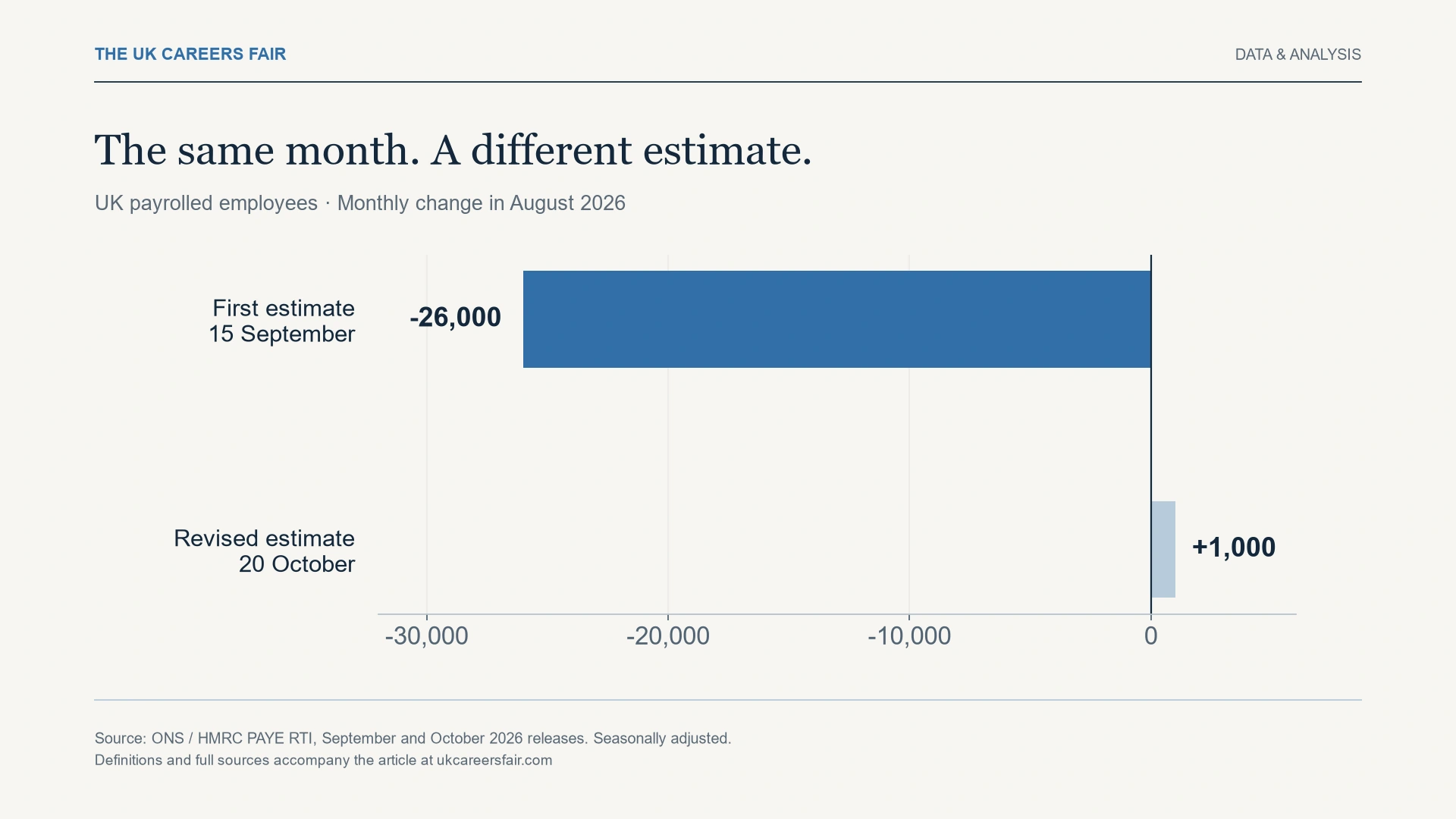
One of the most instructive numbers in October’s labour-market release concerns August. The initial estimate said UK payroll employment had fallen by 26,000 on the month. The updated estimate said it had risen by 1,000.
The change did not mean 27,000 people had suddenly found work between the two announcements. It meant the statistical picture of the same month had changed as more information became available. The September release reported the initial fall; the 20 October ONS and HMRC bulletin incorporated additional payroll submissions and revised August’s monthly movement upwards.
That is a useful lesson for any business publishing its own recruitment figures. This week’s audit of UK Careers Fair bookings produces an apparently simple pair of numbers: 951 organisation-event commitments in the observed 2026 cohort and 145 for 2027. Turn them into a percentage change and the arithmetic would be easy. The story would be wrong.
Two numbers can be correct and still make a bad comparison
The 2026 records cover catalogued fairs from 2 July to 6 November. The 2027 records concern a future programme, observed before most of its events are close to taking place. One cohort is largely in the past; the other is largely ahead. Their event coverage and booking windows differ.
There is a further problem. The historical import contains 303 booking rows with a 1 January 2026 placeholder receipt date. Those dates cannot establish when the underlying customers actually made their decisions. Sorting by them would make an administrative migration look like a burst of booking activity.
The published audit method therefore rules out a year-on-year growth claim. It can establish 145 active commitments for the current 2027 programme, after reconciling organisation names, cancellations and event moves. It cannot establish whether that total is ahead of, or behind, the equivalent position last year.
This is not the same issue as the ONS revision. ONS is updating an estimate of a defined population using additional submissions. Our problem is whether two administrative cohorts are comparable at all. Both illustrate why a number needs a history and a definition before it can carry a headline.
Revisions are information about the measurement
The payroll bulletin explains that its early estimates typically use around 85% of the information, rising to 98–99% in the following month. A first estimate is deliberately timely; a later one benefits from more complete reporting. ONS publishes a revision triangle so readers can see how successive estimates change.
A revision history makes the uncertainty visible. Without it, a reader encountering only the latest August figure could miss that the previous reading had the opposite sign. Equally, a reader repeating the first estimate without its provisional status could describe a decline that the subsequent data no longer show.
The fair-booking equivalent is to preserve the original snapshot and explain what changes. A new accepted booking is different from the same customer moving to another date. A cancellation is different from removing a duplicate. A corrected organisation name can change a unique-name count without changing the number of participating people or stands.
What the next comparison should measure
For this programme, a credible follow-up starts from the 3 November baseline, keeps the counted unit fixed and separates genuine booking changes from corrections. It should identify additions and cancellations, state whether the calendar itself has changed, and explain any alteration to the treatment of organisation names.
Even then, an increase in bookings would be an increase in bookings. To make a claim about vacancies would require vacancy evidence. To make a claim about successful hiring would require outcomes, a defined follow-up period and a clear account of what can be attributed to the event.
For candidates, the practical implication is to read the period and the population before treating a national headline as a verdict on a local search. For employers, it is to ask the same questions of a supplier’s impressive percentage as of an official release: compared with when, counted how, and revised since?
The revised August payroll figure and the new careers-fair snapshot are different kinds of evidence. Read carefully, both are useful. The mistake is to ask either to answer a question its underlying records were never designed to settle.
About this reporting: The UK Careers Fair organises the events and operates the Jobs Board discussed here. Booking figures are a snapshot at 21:35 UTC on 3 November 2026; the board-wide salary audit is at 21:38 UTC. They are not representative estimates of UK employment. Read the definitions, limitations and aggregate data. Charts are original visualisations of the cited figures.