
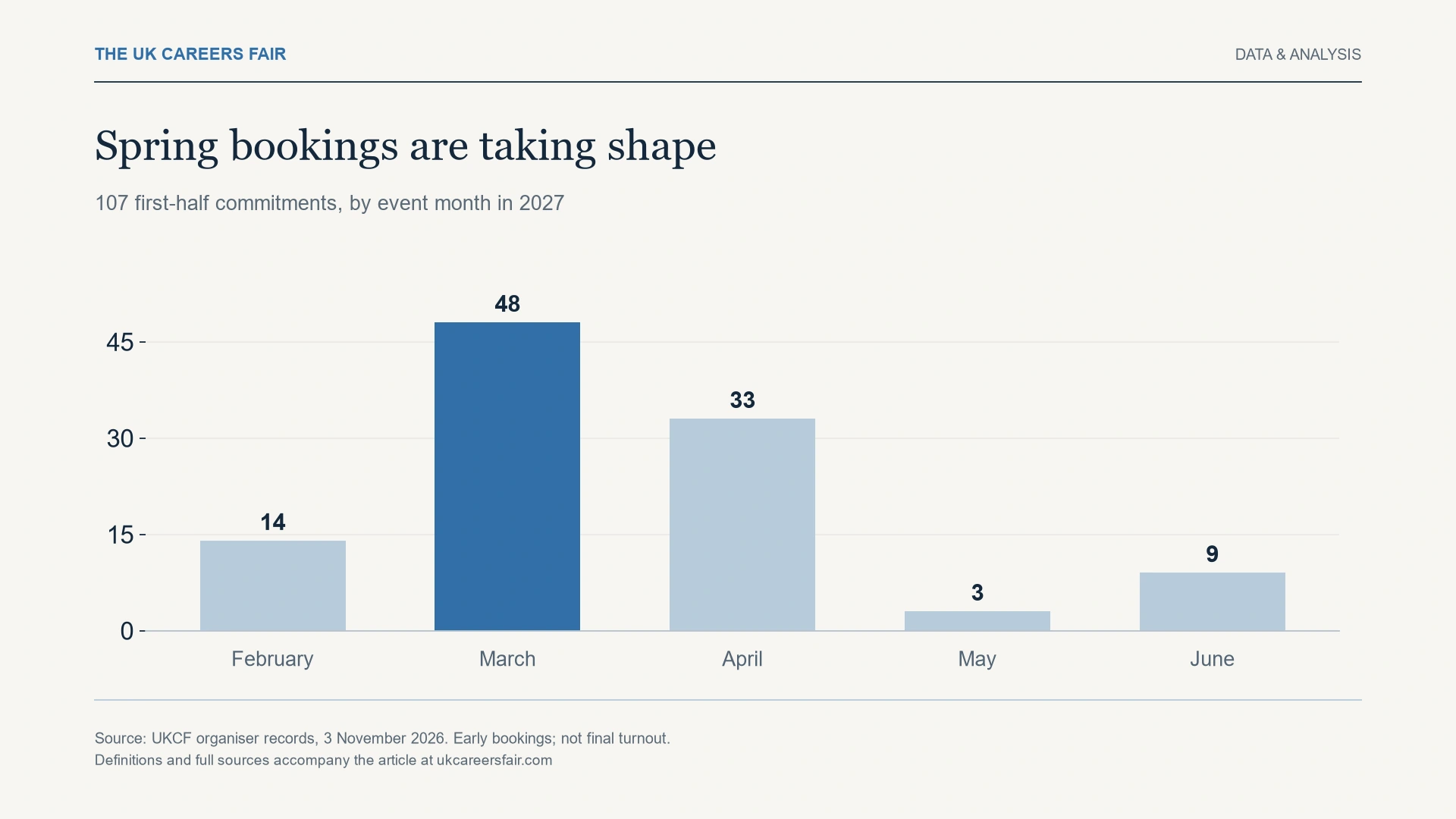
Organisations have recorded 107 event commitments across 45 cities for the first half of The UK Careers Fair’s 2027 programme, according to an analysis of the organiser’s booking ledger. The commitments cover 47 events and 72 normalised organisation names, with the first booked dates falling on 24 February.
The 3 November snapshot captures a programme still taking shape months before the opening fairs. It counts accepted bookings after moves, cancellations and duplicates have been reconciled. A commitment means one organisation at one event; several appearances by the same organisation count separately. The figures describe planned participation and do not establish vacancy numbers or final line-ups.
The opening week crosses five regions
The first booked events are Northampton at Northampton Guildhall and Reading at The Penta Hotel, both on Wednesday 24 February 2027. They are followed by Newport at Riverfront Theatre and Wolverhampton at Grand Palace Wolverhampton on Thursday 25 February, then Swindon at STEAM Museum on Friday 26 February.
Those five events account for 14 commitments in the current records. March holds 48, April 33, May three and June nine. The monthly table describes bookings received by the snapshot, rather than a forecast of each month’s final attendance or recruitment activity. A fair with only an early booking recorded has months in which its line-up can change.
The geographical reach is already broad. The first-half cohort includes 17 commitments in the North West, 17 in the South East and 15 in Scotland. These totals sit within different event programmes, so their ranking cannot establish which region has the strongest hiring demand. The published data includes the number of scheduled events in each region to make that difference visible.
What the advance calendar makes possible
For candidates, a published date creates time to make an event practical. The relevant questions can be specific: how to reach the venue, whether the journey is manageable, what access arrangements are needed and which kinds of work are worth discussing. The opening week spans five regions; choosing a date still requires attention to the journey and to the work someone wants to find.
The calendar can also become a useful deadline for preparation. Someone considering a change of occupation can use the intervening weeks to identify the experience they can evidence and the training questions they need answered. A candidate already searching can assemble examples of their work and check current advertisements. The value lies in arriving with a clearer basis for a conversation, rather than assuming an early booking count reveals every opportunity that will be available.
For exhibitors, the same lead time allows the event to be connected to an actual application process. Representatives will need accurate information about the work on offer, its location and hours, the evidence applicants should provide and what happens after the conversation. Where an organisation is discussing training or support services, that purpose needs to be clear too. The ledger records organisations’ participation; it does not classify every stand as an employer with vacancies.
A developing line-up, with a clear baseline
The first-half calendar contains 56 scheduled events. Bookings are currently recorded against 47 of them. That is useful evidence of the programme’s developing coverage, but the nine remaining events cannot be treated as evidence of weak local demand. An administrative booking snapshot captures one organiser’s records at one time, and the fairs themselves remain several months away.
The 72 organisation labels also appear across different numbers of events. Candidates should therefore expect the relationship between places, dates and participants to matter: 107 commitments do not mean 107 separate organisations. Normalising names removes routine spelling and legal-suffix differences, while leaving the total short of an independently audited legal-entity count.
As the opening week approaches, the useful reporting question will be how the line-ups develop and what participating organisations can substantiate about their opportunities. For now, the November ledger provides a precise baseline: 107 accepted first-half commitments, spread across 47 events in 45 cities, with Northampton and Reading opening the booked programme on 24 February.
Sources
The UK Careers Fair booking snapshot, 3 November 2026, including the first-half, monthly and regional tables; and the official event pages linked above for dates and venues. Event details can change, so candidates and exhibitors should check the relevant page before arranging travel.
About this reporting: The UK Careers Fair organises the events and operates the Jobs Board discussed here. Booking figures are a snapshot at 21:35 UTC on 3 November 2026; the board-wide salary audit is at 21:38 UTC. They are not representative estimates of UK employment. Read the definitions, limitations and aggregate data. Charts are original visualisations of the cited figures.