
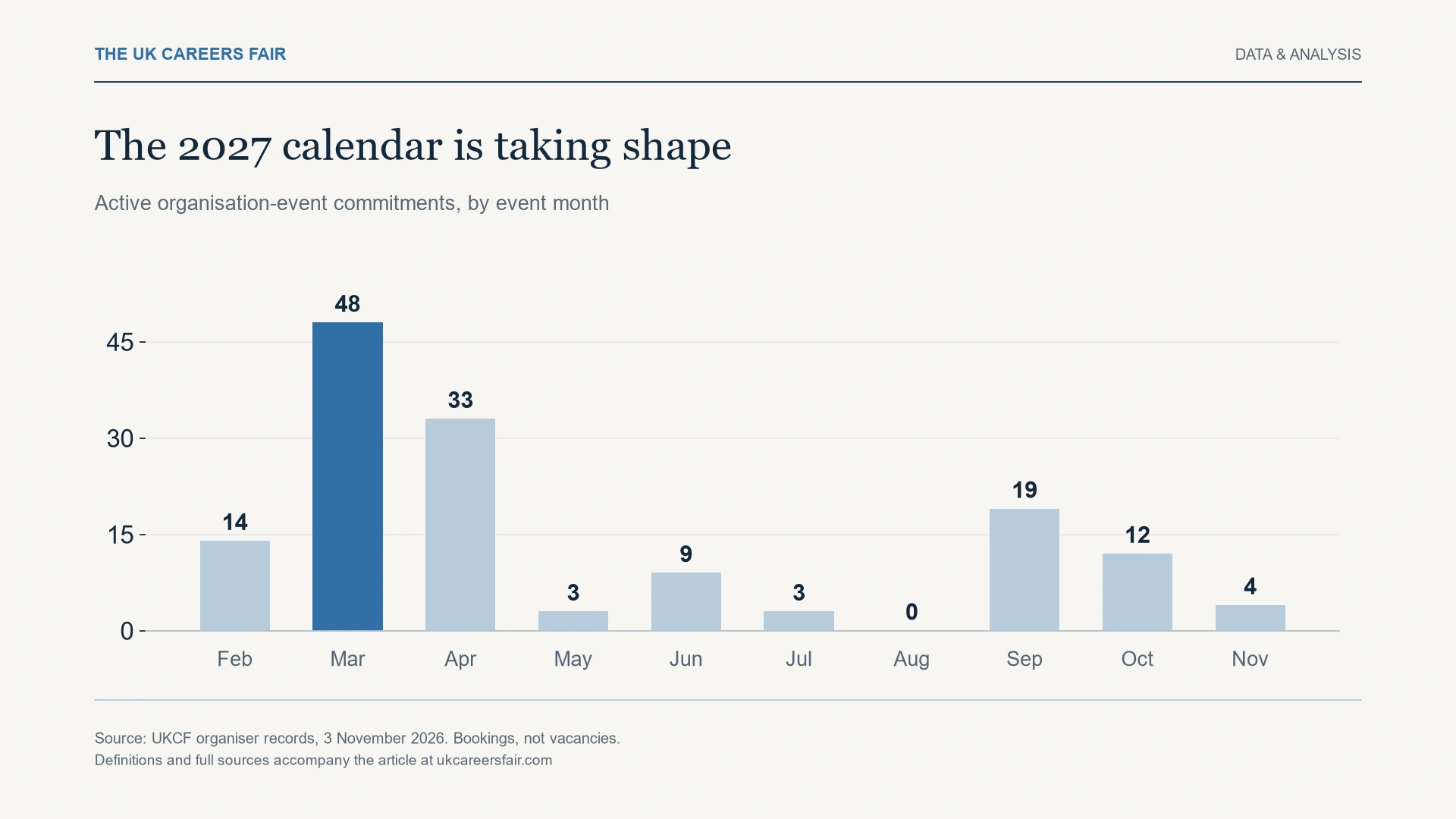
The next recruitment year is already being pencilled in. With almost two months of 2026 still to run, The UK Careers Fair has recorded 145 active organisation-event bookings for its 2027 programme, spread across 50 cities.
The figure comes from a new reconciliation of the organiser’s booking records, completed on 3 November. It represents 81 distinct normalised organisation names participating in 72 events. Some organisations have booked once; others have committed to a sequence of dates. Together, they offer a first view of how one national careers-fair programme is taking shape well before the new year.
It is a view of planning, rather than a forecast of employment. A place at a careers fair can support immediate recruitment, a later intake, training or careers advice. The records do not say how many people will be hired, or whether every participating organisation has a vacancy today. The published dataset and counting method make those boundaries explicit.
What has actually been committed
The unit is simple: one organisation at one event. A booking for five fairs therefore produces five commitments, while two contacts booking the same organisation into the same fair do not produce two. Cancellations and event moves have been applied before the totals are calculated.
This distinction changes how the headline should be read. There are 145 commitments, not 145 separate employers, and the organisation count includes the wider careers ecosystem. The names have been normalised to remove straightforward variations in punctuation and company suffixes; they have not been audited as separate legal entities or corporate groups.
The geographical spread is already substantial within this programme. Bookings reach 50 of its 63 scheduled cities and 72 of its 110 scheduled events. That is participation across roughly two-thirds of the calendar, not a measure of how full the venues are. A date with one organisation booked and a date with several both count once in the event coverage figure.
Spring is taking shape first
Of the 145 commitments, 107 relate to events in the first half of 2027. That cohort covers 45 cities and 47 events, starting with booked dates in Northampton and Reading on 24 February. March accounts for 48 commitments and April for 33. These are event months, not the months in which customers placed their orders.
The distinction matters for anybody trying to read momentum into the numbers. This is one snapshot. It establishes that planning has happened, but it cannot establish that bookings are arriving faster than a year ago. The historic records include migrated entries whose recorded receipt dates are placeholders. Publishing a growth rate from those timestamps would create precision the evidence does not support.
Nor does the first-half concentration establish a seasonal peak in hiring. Earlier events have different lead times, and the calendar offers a different number of dates in different months. A fuller account will require later snapshots of the same programme, taken on a consistent basis.
The practical significance of an early calendar
For candidates, the advantage is time to investigate. A fair date is a prompt to examine the organisations expected to attend, find out whether they are discussing current vacancies or future routes, and decide what information would make the visit worthwhile. The relevant question is not simply whether an organisation will have a stand, but what conversation a visitor can have there.
For an exhibiting organisation, an early booking creates a planning deadline. The team can decide which roles or pathways it will discuss, who can answer detailed questions, and where interested candidates should go afterwards. Those are practical uses of a calendar commitment; they are not outcomes measured by this audit.
The 2027 events calendar provides the current dates and venues. The Jobs Board is a separate source of advertised opportunities, which should be checked for location, eligibility and closing date. An organisation’s appearance in one should never be assumed to mean that every opportunity it offers appears in the other.
The early picture is therefore specific, and useful: organisations are already reserving opportunities to meet candidates across a broad programme. Whether those conversations become applications, interviews and hires is the next question—and one that bookings alone cannot answer.
About this reporting: The UK Careers Fair organises the events and operates the Jobs Board discussed here. Booking figures are a snapshot at 21:35 UTC on 3 November 2026; the board-wide salary audit is at 21:38 UTC. They are not representative estimates of UK employment. Read the definitions, limitations and aggregate data. Charts are original visualisations of the cited figures.