
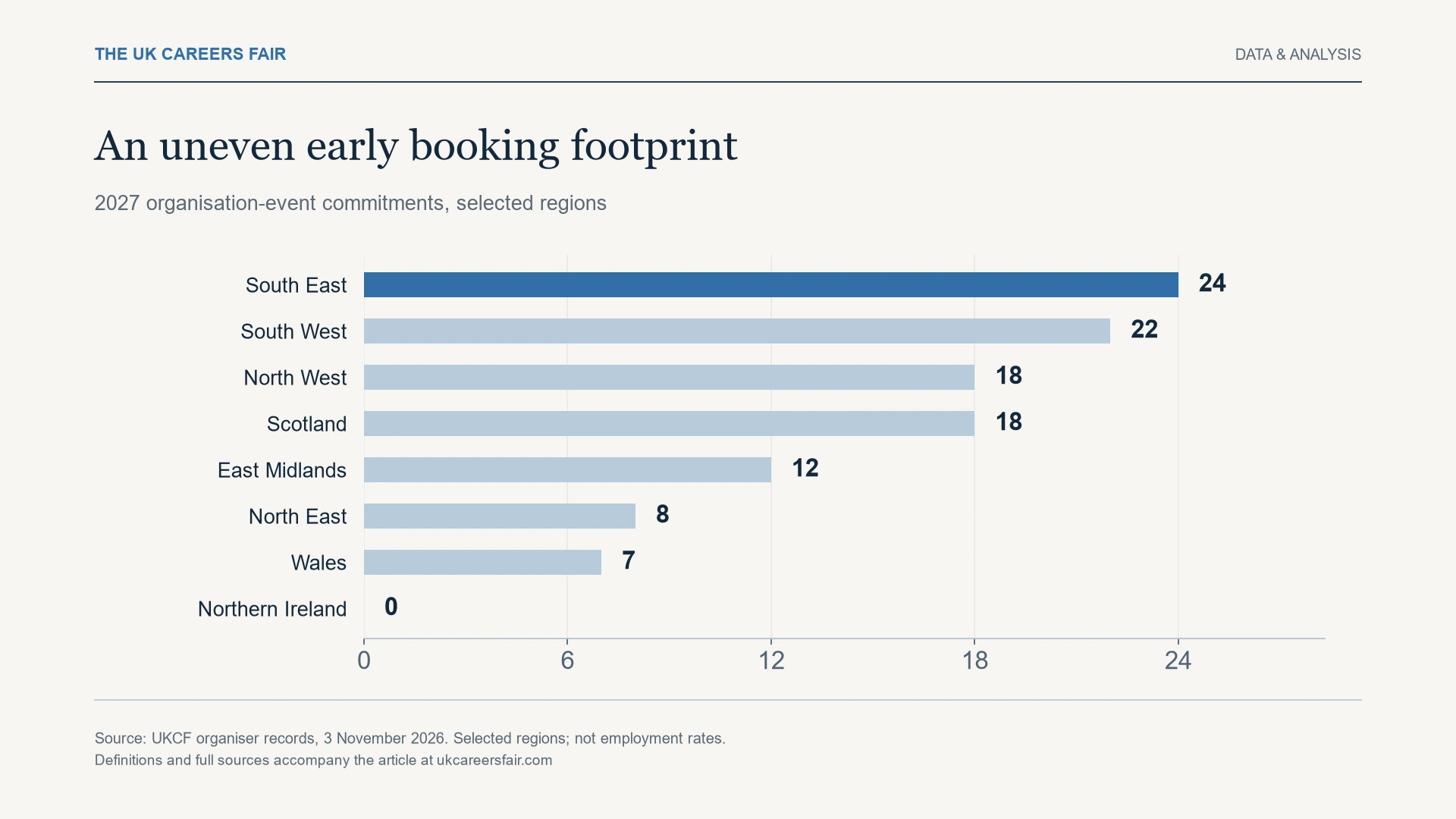
Accepted commitments for The UK Careers Fair’s 2027 events already extend across areas with markedly different employment rates. The new organiser audit records 22 organisation-event commitments in the South West and eight in the North East. It is a map of future participation, sitting alongside a much broader picture of people already in work.
The ONS regional release of 20 October puts the South West employment rate at 79.2% and the North East at 70.5% for June to August 2026. These seasonally adjusted estimates concern people aged 16 to 64. The booking snapshot, taken on 3 November at 21:35 UTC, concerns accepted commitments to events in the following year.
Putting those columns together is useful chiefly because it makes the questions clearer. It cannot establish that a higher employment rate attracts more exhibitors, that a lower rate means fewer opportunities, or that this organiser’s network represents the regional economy.
Two denominators, with a calendar between them
An employment rate divides employed residents aged 16 to 64 by the population of that age, as the ONS statistical guide explains. The booking count adds distinct accepted organisation-event commitments within one organiser’s programme. An organisation attending more than one fair can contribute more than one commitment.
The table adds a third, necessary piece of context: how many events are scheduled in each selected area. A larger programme offers more occasions on which a commitment can be recorded. It still provides no denominator for the region’s whole population of employers, training providers or potential visitors.
| Event location | Scheduled 2027 events | Accepted organisation-event commitments | ONS employment rate, ages 16–64 (%) |
|---|---|---|---|
| South East | 11 | 24 | 78.6 |
| South West | 12 | 22 | 79.2 |
| North West | 14 | 18 | 74.9 |
| Scotland | 11 | 18 | 74.0 |
| East Midlands | 9 | 12 | 76.3 |
| North East | 8 | 8 | 70.5 |
| Wales | 6 | 7 | 73.3 |
| Northern Ireland | 2 | 0 | 72.5 |
Sources: The UK Careers Fair audit and current programme; ONS, June–August 2026 employment estimates. The selection is illustrative rather than a complete regional listing.
The same count can sit inside a different programme
The North West and Scotland each have 18 accepted commitments. The schedule contains 14 North West events and 11 in Scotland. Even the identical booking total therefore sits within a different set of opportunities to participate.
A further distinction is whether commitments reach the same events. In the North East, eight commitments cover six of eight scheduled fairs. In the South West, 22 cover nine of 12. These event-level audit totals reveal the shape of early participation, not the eventual size of a fair or a candidate’s chance of finding work there.
Northern Ireland makes the limitation especially clear. Two events are planned, but the snapshot contains no accepted 2027 commitments there. Zero is a statement about the organiser’s records at a particular time. It says nothing about whether people are employed, employers have vacancies or later participation will be booked.
Location is more complicated than a regional label
The ONS notes assign these employment estimates to where people live. The organiser assigns a commitment to the event’s location. The comparison does not establish where an exhibitor is headquartered, where a visitor lives or where any eventual job would be based.
That matters for a practical decision. Someone living near a regional boundary may find a suitable conversation across it. An organisation attending one fair may discuss work elsewhere. The regional row cannot substitute for checking the actual workplace, travel requirements and entry criteria.
Nor should small changes in an official regional rate be made to carry this interpretation. The ONS guide to survey uncertainty explains why short-term movements require care. This comparison uses the published levels as context, rather than treating a movement between quarters as an explanation for booking behaviour.
The next useful question is local and specific
Across the full programme, the audit records 145 accepted commitments, covering 72 of 110 scheduled events. The participants include employment, recruitment, training and support organisations; the count is not a tally of vacancies. Mixed payment statuses and the absence of a comparable prior-year snapshot also rule out describing it as paid participation growth.
For a candidate, the useful next question is which organisations will be at an accessible event and what each can offer. For an exhibitor, it is which audience and purpose the proposed event serves. Both decisions require information below the regional headline.
The current event calendar can be used to check a particular place and date. The national employment picture supplies context; the booking audit supplies a dated view of this programme. Keeping their units, geography and timing visible makes the comparison informative without turning it into a league table of personal prospects.
Sources
- The UK Careers Fair, audited 2027 booking snapshot, 3 November 2026.
- ONS, Labour market in the regions of the UK: October 2026.
- ONS, A guide to labour market statistics.
About this reporting: The UK Careers Fair organises the events and operates the Jobs Board discussed here. Booking figures are a snapshot at 21:35 UTC on 3 November 2026; the board-wide salary audit is at 21:38 UTC. They are not representative estimates of UK employment. Read the definitions, limitations and aggregate data. Charts are original visualisations of the cited figures.